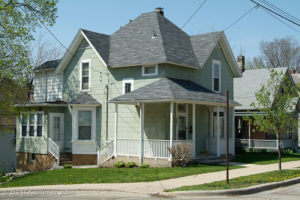
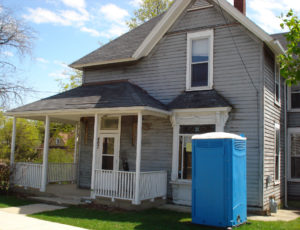
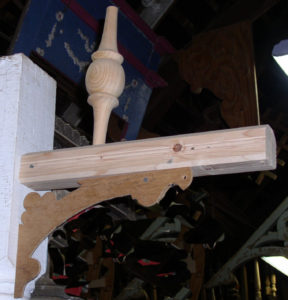
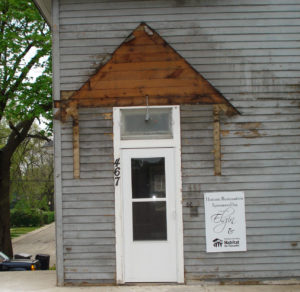
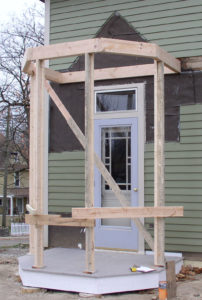
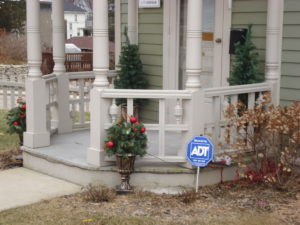
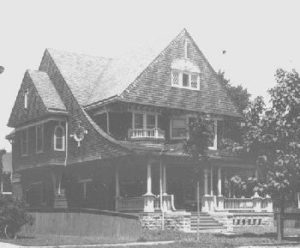
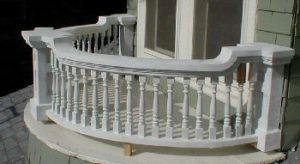
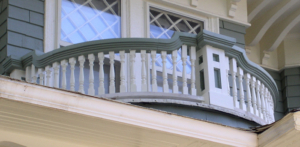
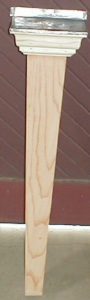
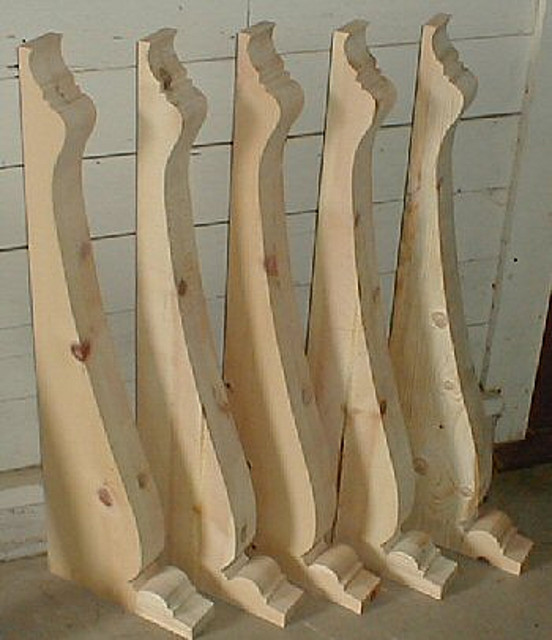
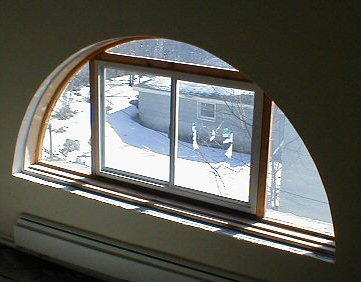
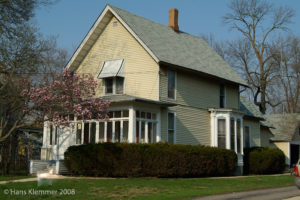
This building was built as three apartments and was later changed into six. It deteriorted badly and was attracting nasty  people as renters.   It origianlly had porches with roofs but was changed into just decks.

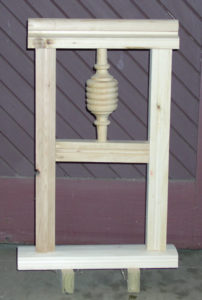
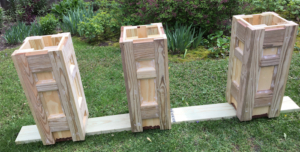
An investor bought it and changed it into four very nice condo units attracting excellent owners.    Each unit has three levels.  He put the porches back but used interior balusters and newels for the exterior porches.  Within years they rotted off. I was a friend of two of the condo owners so I agreed to help as their condo owners assocition had a very limited budget for repairs.  I found a very approprote treated spindle at Menards at an incredibly low price of about $3 each.  They needed a lot.

The condo owners got togeher and while watching sports in the garage primed and painted all of the spindles themselves to save money. This common goal also built their friendships.   I made the newels, finials and rails for them and lent them an air nailer, drills  and chop box  to install them.


I  spnet a half day with them instructing them on the installation.  None of them had any construction experience but did a great job of installing the spindles rails and balusters.  They found it to be very satisfyng and saved a tremedous amount of money. It felt good for me to help them and to get an asset to our neighborhood.


Several years ago the City of Elgin bought this house for $140,000 as it was a bit of a problem property. It had asphalt siding on it. They offered it to our neighborhood organizaiton to rehab.  We had done four problem properties in the past but we felt this one was nice enough that it could be done by an indvidual.


Here is the house with the siding taken off.


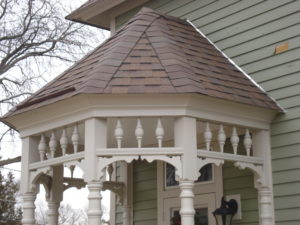
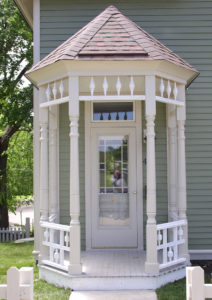
I had always thought the porch was unusual so I checked the Sandborn map and found that it origianlly had a small six sided porch.

The city gave the house to Habitat for Humanity to rehab and they hired an architect to draw up plans for a six sided porch.


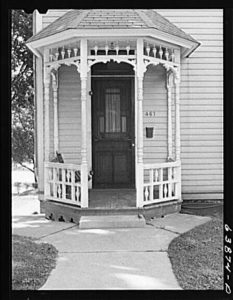
Some time before that a friend and I were looking on the Library of Congress’ web site.  We queried houses in Elgin and found quite a few.  We found the one shown at right that clearly had an address of 467 on it which was his address.  We studied it and came to the conclusion that it was not a picture of his house.    A few months after that I had an epiphany when we were talking about the Habitat house whose address was 467 Division and I remembered the picture from the Library of Congress had an address of 467.  When the siding was taken off of the Habitat house there was a clear mark for the post box shown in the old picture so there was no doubt it was the habitat house.


I voluntered to make the spindles, brackets and rails for the porch


As always, the first thing I did was to make full scale mockups of the details to show Habitat, the Design Review Committtee and to prove to myslef that the scale was right.  I had gotten the dimension by studying the picture keeping in mind I knew the width of the clapboards shown.

When the substitute siding was removed an exact outline of the original porch roof was uncovered.


Here is the finished porch:


The window hoods were taken off when it was sided. A paint outline could be seen on the house for the hoods so I used it to make them for the entire house, all as a volunteer.


When the current owners bought their house it had wide exposure aluminum siding  and the porch balustrade was missing.

The owners have spent years getting the original details replaced.

I made a mockup for a proposed porch balustrade.  I used two sizes of spindles to give them a choice.

The mockup was placed on the house to check for proportions.

I did not make or install their balustrade but my mockup was used as a pattern.  The owners painstakingly painted the spindes themsleves.


Notice the tiny round parade porch with a balustrade on the right of the photograph below.  Sometime after this photograph was taken, that balustrade was taken off.


I made a blaustrade for it using the same design as on the porch.  The rails were made by cutting small sections of a round rail then putting the three layers together by staggering the joints (bricking) for strength. This is the top rail. When it was finally put together it was symmetircal, not as shown in the picture.

This is the bottom rail made in two layers, glued and screwed together.  All the wood used was treated.


This is the finished rail:


This is the new balustrade on this little and very interesting parade porch. To access it you would have to go thru a window.  Only one person could stand out there.  I think it is for looks only, not to be used.  Some people call this a Juliet porch as it looks like what Juliet would stand on to call Romeo.

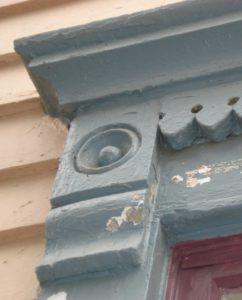
When the aluminum siding was put on the building they took off the keystones to make the surface flat.  I made new keystones for above the attic windows.

The gable ornaments were missing. Chuck Keysor ( [email protected])  made the individal squares on a CNC router from pvc material.

They rented a lift to install  it.  The only projects left onthe extrior restoration are two smaller gable appliques.

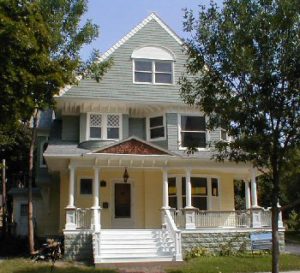
When the current owners purchased 530 S. Liberty they knew the porch posts were unusual and probably not original but they had no idea what would be appropriate for their home as shown below.


At the five year point of their ownership the Historicl Society was given old plan books from some prominent architects.  In it were original drawings of the home showing incredible posts and balustrades, even one above the porch and on the third floor parade porch. What a pleasant surprise and an absolute godsend!!

The home is in the National Watch Historic District so 75/25 grants are available for things like restoring porches. The owners decided to go for it. They did the main porch in one summer with one grant and then got another the next year to do the balustrade above the porch and the parade porch.

John Crowe of Berkley Crowe Masonry was hired to rebuild the foundation.  There is actually a room in the basement under the porch which was  often used as a cooling room for food and vegetables. No living space above it makes it very cool in the winter and huge blocks of ice helps in the summer.

Scott Savel of All Around Home Improvements was hired to do the carpentry. He and his associate Rob did an incredible job.  I love his motto which states, “It’s not just our livelihood, it’s our neighborhood!”

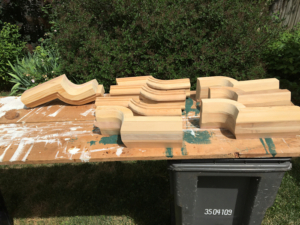
I was hired to make the rails, goosencks on the rails and the finials.  What a pleasure to be able to work on a home of this stature.  I had previously made a lot of goosenecks and had perfected a method to inexpensivley make them.  A company in Chicago does them by having a huge custom shaper head made and charges $250 each for goosenecks.  I do them for $40.  I was very lucky to get my method written up in Gary Katz’s on line magazine, This is Carpentry. If you are interested, here is my article showing the method I use for making goosenecks.

A custom knife wa s made to cut the fancy profile on the rails.  The exact profile was not known so one that is common in Elgin was used.  The goosenecks then were made to match the rails. Scott had to do a lot of handwork to get them to go together nicely. Goosenecks, finials  and rails were made from cypress which has great rot resistance. Scott made the newel posts from pvc which should last forever.

I hand turned the finials. The design of the finial was taken from the drawing.

Here are some pictures of the finished details.  The porches are a wonderful additon to the streetscape and Elgin.  The owners got a wonderful article in the Daily Herald written about them and won an Elgin Mayor’s award for their extraordinary effort.

This is the third floor parade porch(sorta) balustrade

This is the balustrade onthe porch roof

Porch balustrade.  The spindles were custom made by Mr. Spindle. A huge thanks goes out to Scott Savel for some of the pictures.

Here is Scott Savel leaning on his post to make sure it is strong. The goosnecks on the stair rail were one of a kind so I had to lay the entire balustrade out full scale on a piece of plywood to make the patterns.  Very challenging with the end product being very satisfying.


I was only a small part of the resurrection of this porch but very glad I got the chance to participate.

Our Back Porch

This is our back porch when we bought the house in 1986.  Probably in the 20’s they enclosed the porch and stuccoed the building.  They moved the wall with the window on the left out five feet to enlarge the kitchen for one of five apartments.  The wall on the  right of the door enclosed the porch and hid a back staircase to the second floor apartments.

This picture shows the beginnings of taking the porch apart.  The window was kept and put in the new wall five feet in.  The room on the porch roof was a sleeping porch.  Harriet Beecher Stowe wrote an article  for a  magazine saying that sleeping in an enclosed room with stale air caused Tuberculosis so everyone across the nation built sleeping porches with lots of windows to get fresh air for sleeping.  They even added a radiator to this one. It had to come off with the door into the house being put back into a window.  I was very proud of myself for making an entire double hung window to replace the one that was taken out.

We found marks on the house showing the exact profile of the crowns on the posts.  They were duplicated exactly.  The posts had been installed first with the clapboards coped up to them so we knew the exact width of the post.

We did not have any evidence for the design of the balustrade so after months of searching my wife picked one for an old pattern book. The balusters were very time consuming to make but well worth it.  It is important a balustrade not interrupt the window so it was crucial to have one that is 24 inches high which is often found on Italianate houses in our neighborhood. Italianate houses always have porches that art tall and slender with a low or no balustrade.

Code officials do not like low rails.

 We were lucky to find a paragraph in the BOCA code the city was using at the time which stated that if the item is not life threatening, the code can be sensitively enforced for historic homes.  We brought that to the attention of the code official and were allowed a 24 inch rail on our front and back porches.  The same paragraph can be found in the new International Residential Building code.  Recently it was written as a formal city policy that 24 inch rails can be use citywide.  Contact me if you want a copy. A 30 inch rail is now very commonly built in Elgin.

Store bought lattice looks terrible.  My wife designed the one above making the holes diamond shaped instead of large squares like that from a big box store. It adds a lot of class to the lattice.  I routed the inside edge of the panel and applied a half round home made molding to the perimeter giving it a real classy look.

Here is the finished porch

Here are pictures showing the progression of the porch restoration:


When Bob and Beth Tierney bought 375 Prairie it needed a lot of work.  The porch was rotting off and the paint was peeling. They applied for and got a grant to rebuild the front porch. I made all of the pieces they needed matching the originals exactly – rails, balusters, apron frame, post bases, triangular apron under steps, newel posts and threads.

Bob started the project and by very late fall he was not finished so he tented the whole porch and heated it so he could continue to work.  He even lighted it so he could work at night.

The porch turned out very nicely and Bob and Beth won a Mayor’s award for their efforts.   See the pictures below to see the progression of the making of the porch.


The David C. Cook mansion at 105 N. Gifford  was built in 1885 for David C. Cook, the son of a Methodist minister and prominent Elgin publisher. It cost $10,000 to build.   The wonderful porch as seen in the old picture below is one that we hope to have a chance to get to rebuild.

In the 50’s it had extensive additions to make rooms for a retirement center. Below is a picture from 2008.

Several years ago it was foreclosed upon and has been vacant ever since.  The Gifford Park Association is currently working with the bank in hopes of getting the additions off and rehabbing the building.  Hopefully I will get a chance to participate in rebuilding the porches from the picture.

As an interesting side note, here is a picture of David C. Cooks other house in Piru, CA.  It is currently used as a wedding venue.  Click here for more info and pictures.  It burned to the ground and was rebuilt using the original plans.  If they can do that, Elgin can certainly restore his first home.

David C. Cook’s story is quite fascinating.  His mail order sewing machine accesories business was destroyed in the Chicago fire of 1871. Undaunted, Cook started over in the business of helping the victims of the fire. He opened a mission on North Avenue in one of the city’s most dangerous neighborhoods.  There, he saw the need for Sunday School lesson books written at a level at which these underprivileged students could read.  Cook took on the task of writing and printing “Our Sunday School Quarterly” himself.  His new wife, Marguerite, helped in the venture also, and they began “Our Sunday School Gem” a 16 page magazine, definetely the most popular Sunday School paper of the day.

The business began in the Lakeview neighborhood in Chicago, but when it outgrew that spot, they moved operations to an old wollenmill in Elgin.  Incorporated as the David C. Cook Publishing company, the firm’s publicatins soon had a circulation of 5 million copies per month, and even the Elgin Post Office had to move to bigger quarters, to accomadate the overwhelming increase in mail handling.

Thanks goes out to the Gifford Park Associaton for the above account found in their Housewalk booklet from when the home was featured on the  Historic Elgin House Tour.

If you would like to see interior pictures of the house before details were removed click here.

396 Division had its original front porch taken off some time ago as shown below.

Luckily there are old pictures of the home available showing a front porch.

An appropriate porch was put back.New porch at 364 Division

Here is the home before the paint was stripped off.


Taking the paint off made an incredible difference as shown below

364 Division


In the 50’s the home shown below was moved across the street to make room for parking and an addition onto Elgin High School.

There is an old picture of the house that was found at the Historical Society Museum.  It shows that  the tiny parade porch above the main porch  had a curved balustrade on it.

I replicated the little balustrade using the same design as the porch only shorter.parade porch balustrade at 59 S. Gifford

The old picture also shows that there was a huge keystone above the attic window. I made one to replace it. Ten years after I made it, it finally got installed in 2020.


The porch was missing some of its long brackets so I made some to match.


The side second-floor window had its fanlight window removed.


I made one to replace it as shown at right.


A huge thanks goes out to John Anderson and Paul Cayez for rehabbing this great house.  For many years it was a problem property with several rental units.  It is now a single-family home with great owners.

The current owner recently made repairs to the porch.

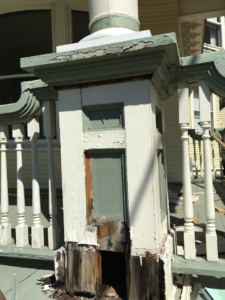
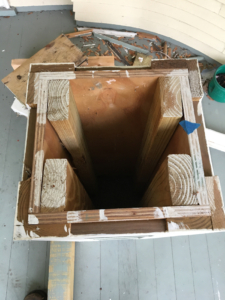
The front porch piers were rotten.  I made all new ones to replace the old. The picture below shows a rotten one.

Here are the new ones I made from treated lumber so they will last forever.

Many of the gooseneck sections of the rail were rotted so I made new ones as shown below:

They are made of cypress which has great rot resistance plus they are coated with a preservative.

Many of the column bases were rotten so I made new ones.

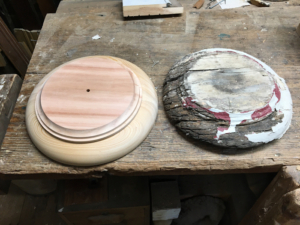
I believe they were originally made on a shaper with a custom knife.  That would be expensive today if only a few are needed.  I turn them on the lathe.

This home was designed by famous Elgin architect W. W. Abell.  Here are other homes he designed.

This home is next door to ours.   In the 25 years we have lived here it was filled with too many people with too many cars and too many kids.  It was foreclosed upon and put on the market in 2010.  We decided to buy it to improve our quality of life.  We had to stare at the aluminum siding since 1988. We knew the enclosed porch with Praire influenced windows was not original on an 1870’s house so we looked forward to adding an appropriate porch.   We spent the next four years doing a historically sensitive rehab of the home.  We worked on it almost every day, all day for four years.  We did everything ourselves except the plumbing (can’t do it yourself on a property you do not live in) and I made the parts for the new porch but did not build it (can’t get a grant for work you do yourself.) Scott and Rob from All Around Home Improvements in Elgin reinforced the basic structure, instlled new cement piers and built the new roof including soffit and fascia.
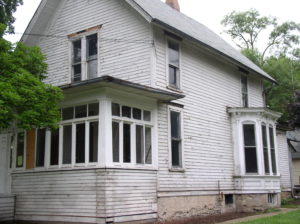


We recived a $5000 grant from the City of Elgin to take the aluminum siding off of the house and garage.


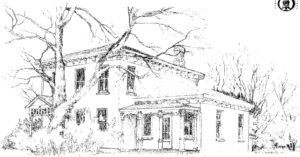
We have a passion for porches so we wanted this one to be special.  We took elements from other old houses and combined them to make our porch.  We especially liked the posts on a house in S. Elgin that was vacant and falling down as seen in the drawing below.

Huge No Trespassing signs kept me from going on the property to copy elements.  I tried to write to the owner to get permission to copy the posts but he did not respond.   I finally called the city of South Elgin about it as I read in paper the city was forcing the owner to demolish it.  When I called they said the bulldozers were there as we speak.  I immediately went there to find the porch to be in the dumpster already.  I gave the two equipment operators $20 each and asked if I could go in the dumpster for five minutes.  I’m glad the boss was not there as no one would normally allow it because of liability concerns.    They allowed me and I was able to get the elements I wanted to copy.  Destiny!

A huge thanks goes out to the city of Elgin for awarding us a grant to pay for half of the cost of rebuilding the porch.

Here are pictures showing the progression of the making of the porch. A huge thanks goes out to Scott Savel and his assistant Rob from All Around Home Improvemnts for their great work.  Scott says that some call him “anal retentive”. In Scott’s case it is a huge compliment.  He pays special attention to the details.  Cuts are perfect and everyting is absolutely level and plumb. That made adding the details after Scott built the structure very easy.

Here is the finished porch.

OLYMPUS DIGITAL CAMERA

We were very fortunate to get our project featured in The Old House Journal – my bible since 1975.  Click here to view it.

If you would like to see interior pictures of this house, click here.  

© Copyright 2017 - Old House Porches - Dan Miller Site Design by Resonate   Resonate Web Marketing  |   Log in